▲
1
▼
 The fish Herabuna, which only appears in this game, is the only Japan-exclusive fish in the Animal Crossing series.
▲
1
▼
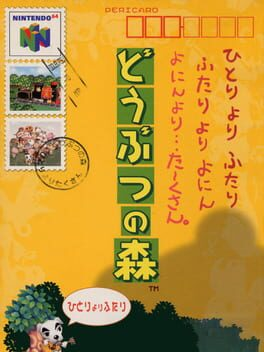
Dōbutsu no Mori (Animal Forest) was the last first-party title to be released for the Nintendo 64 in Japan.
▲
1
▼
The game was originally developed for the Nintendo 64 Disk Drive, and would've utilized the console's internal clock to track real-world time, making the game seem truly alive. However, because of the Disk Drive's commercial failure, Dōbutsu no Morí, like many others, was moved to a standard Nintendo 64 cartridge, with the internal clock being built into the cartridge itself.
This trivia has been marked as "Not Safe for Work".
It may not be appropriate for all visitors and definitely isn't appropriate for work or school environments.
Click here to unhide it.
It may not be appropriate for all visitors and definitely isn't appropriate for work or school environments.
Click here to unhide it.
▲
1
▼

subdirectory_arrow_right Animal Crossing (Game)
▲
1
▼
Animal Crossing for the GameCube is a direct port of the Japanese-only Nintendo 64 Doubutsu no Mori (Animal Forest) so it takes up very little space on the GameCube disc. The entire game is loaded into the GameCube's RAM, and as a result, after the player enters their town they can remove the game disc from the GameCube and continue to play the game normally.
▲
1
▼
 In the iQue release, the Carp is recolored red.
▲
1
▼
 Among the files included in the Gigaleak, a massive 2020 content leak of internal data from Nintendo, are models associated with Dōbutsu no Mori depicting three human characters not seen in the final game: two redcoat soldiers, one tall and one short, and a middle-aged woman in an apron. These characters appear to be early versions of Copper, Booker, and Joan, respectively, which is corroborated by the fact that the woman's filename is "oba," with Joan's sleeping animation being labeled "Sleeping_Obaba" in the files for Dōbutsu no Mori.
All of this appears to indicate that special characters were originally intended to be human before being changed to unique animals later in development; in the final game, the only humans that appear on-screen are the player characters. Copper and Booker would later reincorporate the scrapped redcoat motif in Animal Crossing: Wild World and Animal Crossing: City Folk.
▲
1
▼
A total of 199 music tracks were composed by Kazumi Totaka, Kenta Nagata, Toru Minegishi, and Shinobu Tanaka for Dobutsu no Mori.
▲
1
▼
Among the files uncovered in the 2020 Gigaleak, a massive breach of internal server data from Nintendo, are early assets for characters who do not appear in the final game:
• Early textures for Wisp and Blathers. Given that both characters would later debut in Animal Crossing and Doubutsu no Mori e+, the presence of these assets reveals that they were originally planned for the N64 game before being held off and redesigned for the GameCube ports. Both early models feature different faces for the characters, with Blathers in particular resembling Celeste, who would debut in Animal Crossing: Wild World (implying that her design likely drew inspiration from Blathers' scrapped N64 model).
• Textures for a scrapped female cat villager with the internal ID CAT13. As villagers were not originally intended to change clothes, her default outfit, a Beatnik shirt, is included in her texture pack. However, no other data for her is present, leaving it unclear what her personality was going to be. The CAT13 ID (also written as CATD in hexadecimal) was ultimately given to Ankha in Animal Crossing; it is unknown if the original CAT13 evolved into Ankha during development or if she was simply assigned the ID for the sake of convenience. In Wild World onward, which uses a new ID system, the cat13 ID (spelled in lowercase this time) is instead given to Stinky (whose ID was CAT8 in the N64 and GameCube installments).
• An ID for a scrapped bear villager, BEA3. No additional data is present in the leaked files, with their associated folder being completely absent, and no villagers in Animal Crossing reuse their ID.
• Early textures for Wisp and Blathers. Given that both characters would later debut in Animal Crossing and Doubutsu no Mori e+, the presence of these assets reveals that they were originally planned for the N64 game before being held off and redesigned for the GameCube ports. Both early models feature different faces for the characters, with Blathers in particular resembling Celeste, who would debut in Animal Crossing: Wild World (implying that her design likely drew inspiration from Blathers' scrapped N64 model).
• Textures for a scrapped female cat villager with the internal ID CAT13. As villagers were not originally intended to change clothes, her default outfit, a Beatnik shirt, is included in her texture pack. However, no other data for her is present, leaving it unclear what her personality was going to be. The CAT13 ID (also written as CATD in hexadecimal) was ultimately given to Ankha in Animal Crossing; it is unknown if the original CAT13 evolved into Ankha during development or if she was simply assigned the ID for the sake of convenience. In Wild World onward, which uses a new ID system, the cat13 ID (spelled in lowercase this time) is instead given to Stinky (whose ID was CAT8 in the N64 and GameCube installments).
• An ID for a scrapped bear villager, BEA3. No additional data is present in the leaked files, with their associated folder being completely absent, and no villagers in Animal Crossing reuse their ID.
subdirectory_arrow_right Animal Crossing (Game), Doubutsu no Mori+ (Game), Doubutsu no Mori e+ (Game), Dòngwù Sēnlín (Game)
▲
2
▼
Animal Crossing is only one of five different versions of the same game, three of which were only released in Japan, and one of which was only released in China. The first version was for the Nintendo 64 in 2001, entitled "Dobutsu no Mori", which translates to "Animal Forest". The second version, "Dobutsu no Mori+", was an enhanced remake of the original game, released on the GameCube. This was the version that would be localized as Animal Crossing in North America and Europe. The fourth version, "Dobutsu no Mori e+", was a second enhanced remake released on the GameCube including e-Reader card content. The final version was a Chinese localization of the original Nintendo 64 version, Dòngwù Sēnlín, released five years later in 2006 exclusively for the iQue Player.
▲
2
▼
When creating Doubutsu no Mori, directors Katsuya Eguchi and Hisashi Nogami set out to create a game "unlike any that came before", not fitting into any kind of existing genre. However, since it was required for games to be classified into one genre for the retail packaging, they decided to call it a "communication" game.
▲
3
▼
The source code for Doubutsu no Mori contains references to a variety of non-Nintendo Famicom ROMs that would not appear in the final game, including Arkanoid, F1 Circus, and most bizarrely, the bootleg port of Tekken 2 by Hummer Team.
Related Games
Doubutsu no Mori e+
Animal Crossing: New Leaf
Animal Crossing: Happy Home Designer
Animal Crossing: Amiibo Festival
Animal Crossing: Pocket Camp
Animal Crossing: City Folk
Doubutsu no Mori+
Animal Crossing: New Horizons
Dòngwù Sēnlín
Animal Crossing
Animal Crossing: Wild World
Mario Kart 8
Super Smash Bros. for Nintendo 3DS
Nintendo Land
Super Smash Bros. Brawl
Super Smash Bros. for Wii U
Super Smash Bros. Ultimate
Mario Kart 8 Deluxe
Teleroboxer
Cubivore: Survival of the Fittest
Donkey Kong: Original Edition
Game & Watch Gallery 2
Kid Icarus: Uprising
Super Mario Land 2: 6 Golden Coins
Pokémon Conquest
Hyrule Warriors: Age of Calamity
Clubhouse Games: 51 Worldwide Classics
Pokémon: Let's Go, Pikachu!
Mole Mania
Mario Tennis: Power Tour
Fire Emblem: Three Houses
Mario Party: Island Tour
Metroid Prime 4: Beyond
Densetsu no Starfy
Kirby Star Allies
Disney's Magical Mirror Starring Mickey Mouse
Harvest Moon: Friends of Mineral Town
WarioWare D.I.Y.
Poochy & Yoshi's Woolly World
Super Mario 3D World
Diddy Kong Pilot
Kung Fu
Pokémon Shining Pearl
Harvest Moon DS
Mario Tennis Aces
Pro-Am 64
Star Fox Guard
Zero: Tsukihami no Kamen
Daigasso! Band Brothers
Final Fantasy