subdirectory_arrow_right Doubutsu no Mori (Game), Doubutsu no Mori e+ (Game), Dòngwù Sēnlín (Game), Animal Crossing (Game)
▲
2
▼
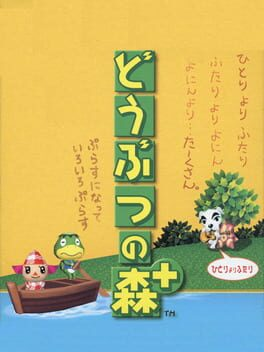
Animal Crossing is only one of five different versions of the same game, three of which were only released in Japan, and one of which was only released in China. The first version was for the Nintendo 64 in 2001, entitled "Dobutsu no Mori", which translates to "Animal Forest". The second version, "Dobutsu no Mori+", was an enhanced remake of the original game, released on the GameCube. This was the version that would be localized as Animal Crossing in North America and Europe. The fourth version, "Dobutsu no Mori e+", was a second enhanced remake released on the GameCube including e-Reader card content. The final version was a Chinese localization of the original Nintendo 64 version, Dòngwù Sēnlín, released five years later in 2006 exclusively for the iQue Player.
subdirectory_arrow_right Animal Crossing (Game)
▲
1
▼
 In the Japanese version, Dōbutsu no Mori +, two paintings that were present in the original Dōbutsu no Mori, the Dreadful Painting and the Novel Painting, are not obtainable in the normal course of play. However, they still exist in the game's code and can be legitimately brought over to a player's save file by importing one from Dōbutsu no Mori (via Nintendo of Japan's now-defunct Data Moving Service), though they can't be donated to the Museum. In the international release of Animal Crossing, however, these paintings are completely removed, and their index numbers instead point to duplicates of the DUMMY furniture item.
It's likely that the decreasing accessibility of these paintings was due to the fact that their real-world equivalents, Edvard Munch's "The Scream" and Piet Mondrian's "Composition with Red, Yellow, and Blue", were still under copyright at the time. The Munch and Mondrian portfolios wouldn't enter the public domain until 2015, well after the Dreadful and Novel paintings were retired from the series.
The Cutting Room Floor article:
https://tcrf.net/Animal_Crossing/Version_Differences#Dreadful_and_Novel_Paintings
Quartz article:
https://qz.com/320717/youre-about-to-see-a-lot-more-legal-versions-of-the-scream
Hyperallergic article:
https://hyperallergic.com/free-at-last-munch-mondrian-and-kandinsky-enter-the-public-domain/
https://tcrf.net/Animal_Crossing/Version_Differences#Dreadful_and_Novel_Paintings
Quartz article:
https://qz.com/320717/youre-about-to-see-a-lot-more-legal-versions-of-the-scream
Hyperallergic article:
https://hyperallergic.com/free-at-last-munch-mondrian-and-kandinsky-enter-the-public-domain/
subdirectory_arrow_right Animal Crossing (Game)
▲
1
▼
 Several clothing items were changed between the Japanese and international releases of the game:
• The Three Arc Shirt (a.k.a. the Familiar Shirt) is replaced with the Fortune Shirt, due to the former's resemblance to Charlie Brown's shirt in the American comic strip Peanuts (which had ended its print run in 2000, shortly before the game's release).
• The Tomato Juice Shirt is replaced with the Fishbone Shirt, due to the former's design resembling bloodstains.
• The W Shirt is replaced with the Houndstooth Tee, due to the former's resemblance to the logo of American fast food chain McDonald's.
• The Puzzling Shirt is redesigned to use more pastel colors, also changing the bottom-center square from orange to purple, to reduce the design's similarity to the Rubik's Cube brand of toy puzzles.
• The I Love GC Shirt (itself a redesign of the I Love 64 shirt from Dōbutsu no Mori) is replaced with the Cherry Shirt, due to the former being a parody of the I ❤ NY logo, which is trademarked by the New York Department of Economic Development.
These redesigns are also carried over to Doubutsu no Mori e+.
subdirectory_arrow_right Animal Crossing (Game)
▲
1
▼
In the Japanese version, Dōbutsu no Mori +, two of the NES games that the player could obtain were Gomoku Narabe and Mahjong. The international release respectively replaces these titles with Soccer and Excitebike.
Related Games
Animal Crossing: Amiibo Festival
Doubutsu no Mori
Dòngwù Sēnlín
Animal Crossing: Happy Home Designer
Animal Crossing
Animal Crossing: City Folk
Doubutsu no Mori e+
Animal Crossing: Wild World
Animal Crossing: Pocket Camp
Animal Crossing: New Leaf
Animal Crossing: New Horizons
Super Smash Bros. Ultimate
Nintendo Land
Mario Kart 8 Deluxe
Mario Kart 8
Super Smash Bros. for Nintendo 3DS
Super Smash Bros. for Wii U
Super Smash Bros. Brawl
Pokémon Picross
WarioWare: Move It!
ActRaiser
Metroid II: Return of Samus DX
Ultimate NES Remix
Pocket Monsters Stadium
Nintendo World Championships: NES Edition
NBA Courtside 2002
Game & Wario
Adventures of Lolo
Pokémon Conquest
Pac-Man 2: The New Adventures
Super Mario All-Stars + Super Mario World
Mario Party 10
Link's Crossbow Training
Radar Scope
Pro Wrestling
Luigi's Mansion 3
Final Fantasy: Mystic Quest
Fire Emblem: Three Houses
Pokémon Battle Revolution
Killer Instinct 2
Dragon Warrior
Mario & Luigi: Paper Jam
The Addams Family
Donkey Kong Country
Metal Slader Glory: Director's Cut
Mach Rider
Popeye
Fire Emblem Warriors: Three Hopes
Battle Clash
Bird & Beans