Platform: Nintendo Entertainment System
Baby Boomer
KlashBall
Tetris
Sunday Funday: The Ride
Tennis
Zombie Nation
Contra
Smash T.V.
Déjà Vu: A Nightmare Comes True!!
Mega Man 5
Godzilla: Monster of Monsters
Snake's Revenge
Dragon Power
Pro Wrestling
MTV Remote Control
RoboCop 2
Cheetahmen II
Mr. Gimmick
Kung Fu
Klax
Super Mario Bros.
Maniac Mansion
Wacky Races
Teenage Mutant Ninja Turtles II: The Arcade Game
Mario Bros.
Spot: The Video Game
Nintendo World Championships 1990
Batman: The Video Game
Monster Party
Snoopy's Silly Sports Spectacular!
Disney's DuckTales
Color a Dinosaur
Captain America and the Avengers
Adventures of Lolo
Wally Bear and the NO! Gang
Star Trek: 25th Anniversary
Tom and Jerry
Rod-Land
Duck Hunt
Mickey Mousecapade
Iron Tank: The Invasion of Normandy
Godzilla 2: War of the Monsters
Tiny Toon Adventures
Yo! Noid
Super Mario Bros. 3
Mario Bros. Classic Serie
New Ghostbusters II
Hatris
Wild Gunman
Donkey Kong
Viewing Single Trivia
▲
2
▼
Popular conceptions about Nintendo's release history in Europe claim that their hardware was never released in the former Eastern Bloc until the 21st century. Rather, these countries instead saw the proliferation of various clone consoles called "Famiclones", such as the Dendy (a Taiwanese-built bootleg that achieved widespread popularity in the Commonwealth of Independent States, made up of the ex-republics of the former Soviet Union) and the Pegasus (which became as popular in Poland as the Dendy did in Eastern Europe). However, while Famiclones did indeed dominate the Eastern European gaming market during the 1990s, Nintendo was not only aware of this, but actively attempted to halt the spread of bootlegs in these regions in favor of officially sanctioned products.
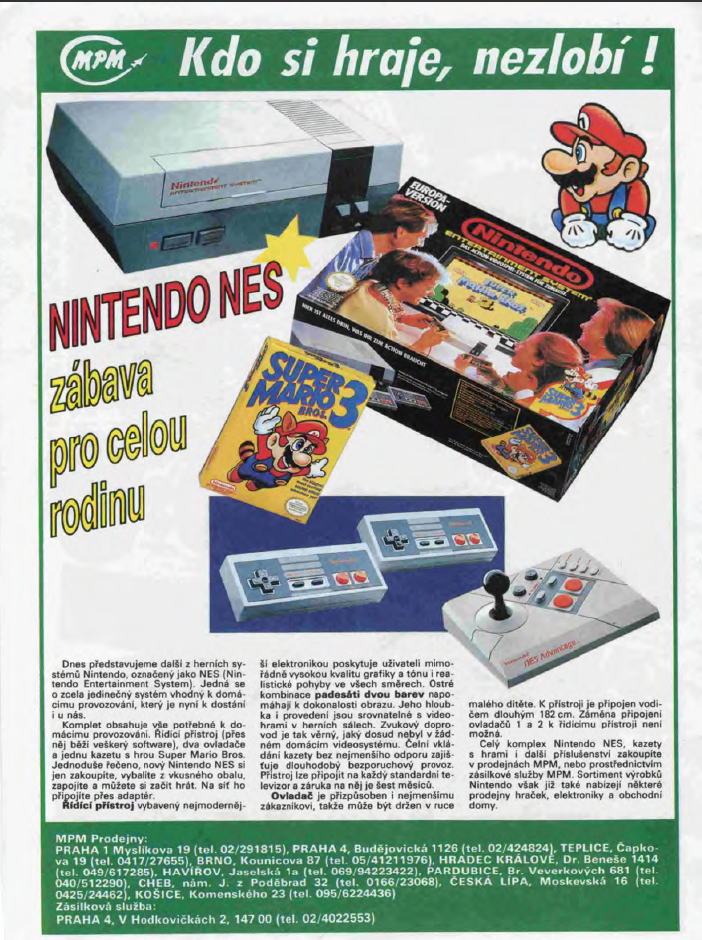
In 1994, Nintendo made a deal with Steepler, the Dendy's distributor in Eastern Europe, to permit continued sale of the Dendy in exchange for equal distribution of the Super Nintendo Entertainment System and Game Boy in the Commonwealth of Independent States; official Russian releases of these systems even included Dendy stickers on the packaging to reflect the arrangement. Meanwhile, in various other parts of the former Eastern Bloc, Nintendo made deals with other third-party distributors; among others, the NES, SNES, and Game Boy saw official releases in Poland, Hungary, and the former territories of Yugoslavia and Czechoslovakia during 1993–1994.
In 1994, Nintendo made a deal with Steepler, the Dendy's distributor in Eastern Europe, to permit continued sale of the Dendy in exchange for equal distribution of the Super Nintendo Entertainment System and Game Boy in the Commonwealth of Independent States; official Russian releases of these systems even included Dendy stickers on the packaging to reflect the arrangement. Meanwhile, in various other parts of the former Eastern Bloc, Nintendo made deals with other third-party distributors; among others, the NES, SNES, and Game Boy saw official releases in Poland, Hungary, and the former territories of Yugoslavia and Czechoslovakia during 1993–1994.
Joshua Rogers video about Nintendo in Eastern and Central Europe:
https://www.youtube.com/watch?v=q75Re7deJC0
Russian-language articles about the Nintendo/Steepler deal:
https://web.archive.org/web/20190427025842/https://www.kommersant.ru/doc/94004
https://web.archive.org/web/20240601223552/https://dtf.ru/games/970617-legenda-o-slone-kak-it-kompaniya-steepler-sozdala-dendy-i-osnovala-rossiiskii-konsolnyi-rynok
https://www.youtube.com/watch?v=q75Re7deJC0
Russian-language articles about the Nintendo/Steepler deal:
https://web.archive.org/web/20190427025842/https://www.kommersant.ru/doc/94004
https://web.archive.org/web/20240601223552/https://dtf.ru/games/970617-legenda-o-slone-kak-it-kompaniya-steepler-sozdala-dendy-i-osnovala-rossiiskii-konsolnyi-rynok
Attachment
Comments (0)
You must be logged in to post comments.