Franchise: Mario
Nintendo World Championships: NES Edition
Paper Mario: Sticker Star
Paper Mario: The Origami King
Mario 128
Mini Mario & Friends: Amiibo Challenge
Super Smash Bros. Melee
Luigi's Mansion 2 HD
Super Mario 64
Mario's Super Picross
Mario Golf: Toadstool Tour
Mario Kart 64
Super Mario 3D All-Stars
Mario & Luigi: Bowser's Inside Story + Bowser Jr.'s Journey
Mario + Rabbids Sparks of Hope
Donkey Kong
Super Mario World: Super Mario Advance 2
Mario Is Missing!
Mario & Sonic at the London 2012 Olympic Games
Mario vs. Donkey Kong: Tipping Stars
Waluigi's Foot Fault
Mario Party
Mario Party 10
Mario Artist: Communication Kit
Dr. Luigi
Mario Tennis
Mario Tennis: Ultra Smash
Super Mario Maker 2
Super Mario 3D World
Princess Peach: Showtime!
Super Mario RPG
Super Mario Odyssey
Mario & Wario
Hotel Mario
Mario's Early Years! Fun with Letters
Mario Strikers Charged
New Super Mario Bros. Mii
Super Mario RPG 2
Mario & Sonic at the Olympic Games Tokyo 2020
Super Smash Bros. for Wii U
Mario & Sonic at the Rio 2016 Olympic Games
Mario's Tennis
Game & Watch Gallery 2
Super Mario Galaxy
New Super Mario Bros. U Deluxe
Yoshi
Photos with Mario
Ultimate NES Remix
Super Mario Bros. 3
Super Mario Galaxy
Mario & Luigi: Paper Jam
Viewing Single Trivia
▲
1
▼
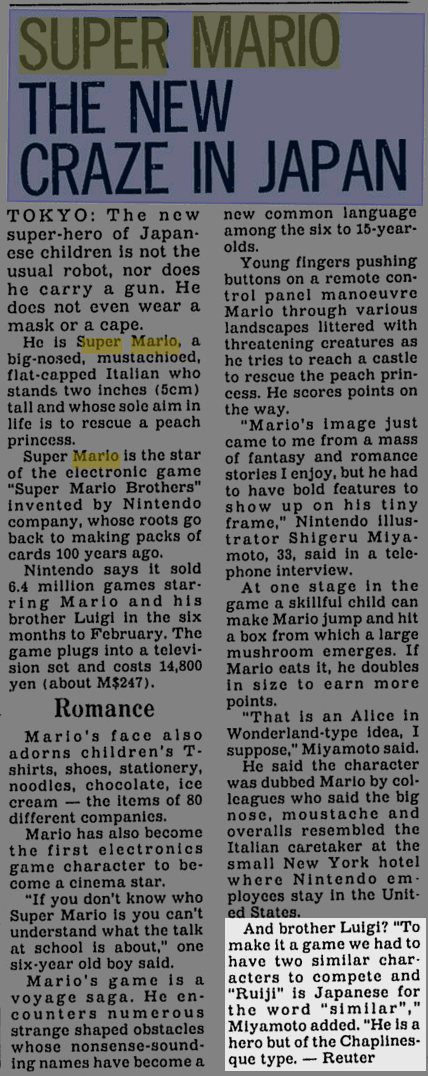
Luigi's name comes from a pun on the Japanese word ルイージ¸ or ruiji meaning "similar". Since all of his sprites in earlier games were just recolors of his brother's sprites, and his name was Italian like Mario's was, it seemed to fit him.
Attachment
Comments (2)
You must be logged in to post comments.

Sorry to disagree, but similar in Japanese actually translates to something else: https://translate.google.com/?sl=en&tl=ja&text=Similar&op=translate
https://en.wiktionary.org/wiki/似る#Japanese
https://en.wiktionary.org/wiki/類似#Japanese
Miyamoto's next sentence in this article describes Luigi as "a hero but of the Chaplinesque type." The fact that he's categorized as a "Chaplinesque type" is an important distinction, because Chaplinesque on its own is used as an adjective for having or trying to emulate the traits of Charlie Chaplin's film characters, but this style being denoted by Chaplin's last name means that his characters' qualities are unique enough that it's inherent that not everyone naturally acts like them. Luigi's timid and occasionally heroic qualities aren't an appearance he's putting on to resemble those characters, he was designed to genuinely behave like them. So in this case "ruiji" is being used correctly to refer to the fact of being similar as Luigi's name originates from a pun meaning that he is a similar type of hero.